
What does maximum soil moisture deficit mean for your subsidence claims?
By Steve Coxon - 14th August 2026

England and Wales have provisionally recorded their driest July in 190 years. On 9 August, the East Midlands, Lincolnshire and Northamptonshire, Kent and East Sussex, and Solent and the South Downs moved into drought status following the National Drought Group meeting, taking the total to 71.3% of England. Rainfall so far in August is running at around 5% of expected levels, and Tony Grayling, strategic drought lead at the Environment Agency, has said conditions will continue to worsen until there is significant and sustained rainfall.
The subsidence figures currently in circulation aren’t yet reflecting that. The ABI’s latest tracker put the average domestic subsidence claim at a record £20,000, with £72 million paid out over the quarter, but those figures cover April to June, attributed to the warmest spring on record so in reality this is just the starting point.
What the soil moisture data shows
The MORECS soil moisture deficit has reached 308.2, the maximum measurable value. Two features of that reading are worth looking at alongside the number itself.
The first is speed. We reached the maximum faster than in any previous surge year since 2003, and 2026 entered the year with an unusually high deficit already in place, higher than 2003 or 2018 so the ground did not start from a ‘normal’ position.
The second is duration as our expectation is that the deficit could stay at this level for some time to come without the peaks and troughs we have seen in previous surge events. I believe 2026 will be a similar surge year to that of 2003.
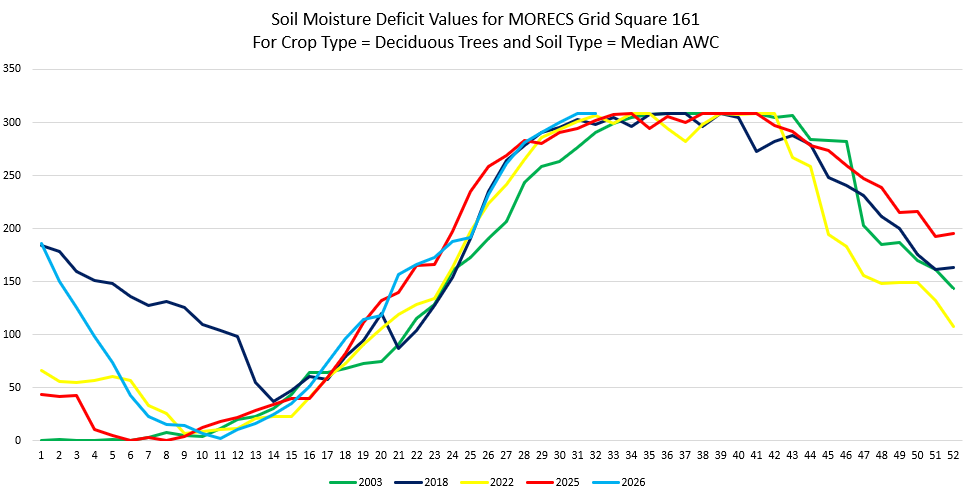
Following the surge of 2025 the soils could not fully recover for any sustained period of time and as a result we have moved into the 2026 summer with the soils already at a moisture deficit compared to previous subsidence surge years. This has resulted in the surge commencing earlier in the year compared to previous event years and the forecast is currently predicting a continued long hot summer.
Furthermore, the extent of the 2025 and 2026 summers is having a further impact in the midlands and the north of the country. As a result, we are seeing more valid subsidence insurance claims spread across the country and not just in the south east.
The surge of 2025 had a significant impact on supply chains across the board including Loss Adjusters, Site Investigations Teams and Repair contractors. Therefore, it is more important than ever to take a close look at the full supply chain and to ensure there is an increased capacity to handle the new claims swiftly and accurately.
The volumes are already here
Across our subsidence portfolio, notification volumes have risen sharply since June, and many insurers are seeing increases of over 500% in August compared to previous months. The usual lag between ground conditions and notification has compressed, which is consistent with a deficit that reached maximum earlier than in previous surge years.
What moves the dial from here is how long the deficit stays at its maximum. I expect the peak across August and September, and the high-volume period runs for as long as the ground holds at that level.
Existing claims are affected too
A surge does not only create new claims. Further ground movement affects claims already in progress, and a claim scoped at £20,000 can rise by several thousand pounds if repairs are delayed and additional movement occurs in the meantime. Therefore, the cost pressure is not confined to new notifications.
The repair timing judgement follows from that, and in a surge, it is being made across a much larger number of claims at once. What matters as much as the decision itself is that it is explained clearly to the policyholder at the point it is made. A repair deferred for sound technical reasons and a repair that has simply stalled look identical from the customer’s side of the conversation unless someone explains the difference.
Three things worth attention now
- Check specialist supply chain capacity now. Site investigation companies, monitoring firms and arborists operate at limited scale, and sustained volumes place them under pressure quickly. Instruction turnaround times in those three move before claim-level SLAs do, which makes them the earliest warning you will get.
- Look at open claims as well as new ones. Reserve adequacy on claims scoped before the drought took hold is worth reviewing, given the cost escalation that further movement brings.
- Settle the communication position on deferred repairs. If repairs are going to be held pending stability, the explanation given to policyholders should be consistent, technically grounded and delivered early. That position is easier to agree once than to improvise repeatedly across a period of high volume.
All three come back to the same thing: certainty established early enough to be useful. That is the principle behind SubsIntelligence, our model for end-to-end subsidence claim control, which connects early triage, evidence-led validation, proactive mitigation and controlled repair into a single journey. A surge year is when the value of getting the front end right becomes most visible.
More on Subs Intelligence Request Case Studies


